Long before Miley climbed the charts, there was Tish – a music aficionado and her children’s first fan. Now, after two decades mothering and managing one of the most successful entertainment families of the 21st century, the 59-year-old is reflecting on the wild ride.
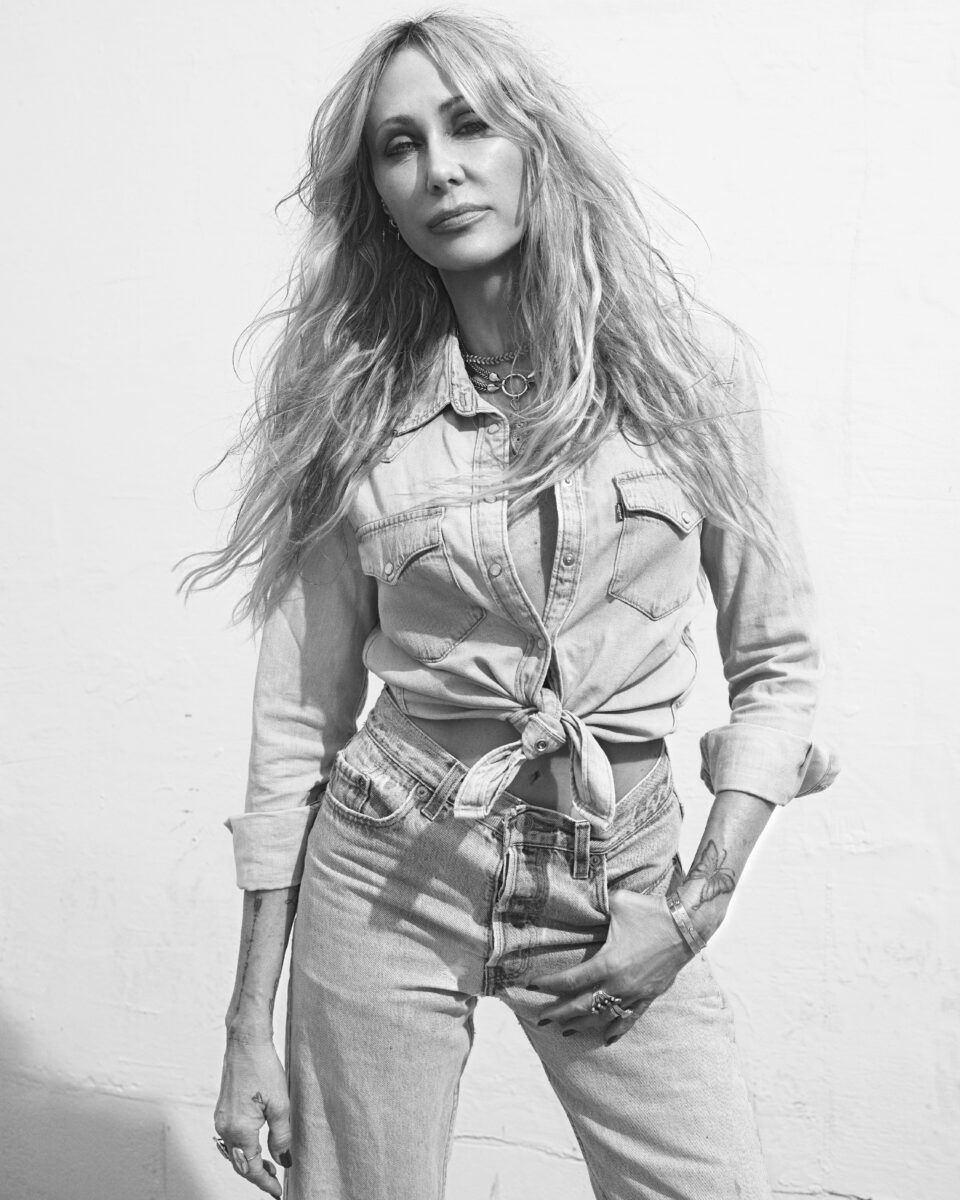
When Tish Cyrus-Purcell smiles, two rows of perfectly symmetrical pearly whites glint with possibility. When she speaks, her textured, Nashvillian twang evokes country radio, dive bar jack-and-cokes, and the comfort of well-worn denim. When she blinks, gesticulates, bestows a quick kiss on her new husband, Australian actor Dominic Purcell, Tish radiates with effortless magnetism. Ultimately, there’s no natural conclusion left to draw other than: this woman is a star.
Correction: Tish is a whole constellation. With the sole exception of Kris Jenner, no mother on the planet has birthed as many Hollywood success stories as 59-year-old, née Tish Finley from Ashland, Kentucky. Her family roster reads like a Hollywood call sheet: Metro Station co-founder Trace Cyrus, her second-born; singer-songwriter Noah Cyrus, the youngest of the brood; DJ Brandi Cyrus, the eldest who co-hosts pop culture interview podcast, Sorry We’re Cyrus, alongside Tish; singer-songwriter-producer and second-youngest Braison Cyrus; and, of course, her third: global pop phenomenon Miley Cyrus.
There’d be no Miley without Tish. One could take that literally, but considering Tish has co-managed Miley for more than two decades, it should also be interpreted professionally.“ So many times with Miley, because she worked so much as a kid, she didn’t have a lot of friends,” Tish recalls. “So I was her friend, her parent and her manager. I think sometimes that’s a recipe for disaster, but for some reason, it just really worked out for us. It just seamlessly worked.
”According to Tish, Miley’s entry into the industry was a complete accident. Hard to imagine, given where Miley stands today: a multi-platinum global superstar with more than 72 million equivalent album sales and three Grammy Awards. As a preteen, she was visiting one of Tish’s friends in Los Angeles, who happened to bring her along to an agency meeting. The agents fell in love with her, offered representation and promptly sent her out for the role of Lavagirl in The Adventures of Sharkboy and Lavagirl. Miley lost the part, but she caught the acting bug – and the attention of Disney.
She had already returned home to Tennessee by the time Disney called again, this time about a middle-schooler living a double life as a pop star. When the then 12-year-old was cast in the titular role ofHannah Montana, Tish packed up and went west.“
I really had no clue what I was doing,” Tish remembers. “But I picked up the entire family,all of us, and moved to LA.”

There’s a reason multiverse theories are so intriguing – the idea of the direction our lives might have taken had we made different decisions at critical moments is inherently fascinating. Miley, likely, doesn’t have to imagine. The child stars who came before her and lacked supportive systems often matured into adults burdened by widely publicised struggles. In Tish, Miley always had a helping hand.
“I was seeing everything that was going on with a lot of these kids in the business, and I think that’s why I just chose to be there every step of the way,” Tish recalls. “She was going through her teenage years, so she needed a parent there. I do think that was so grounding for Miley as she was coming up in this world…I was just there. I was so present in her life.”
When Tish says she was there for every step of Miley’s career, she means it – especially when those steps hit the occasional fact-of-life speed bump. She was there at the 2009 Teen Choice Awards, where Miley sparked backlash for dancing on an ice cream cart during a culture-resetting performance of “Party in the U.S.A.”
“It was not supposed to look like a stripper pole at all,” Tish remembers. “Everything was about things Americans loved. The pole was literally just to hold onto so she didn’t fall off the cart.”It was Tish’s idea to add more than 200 individual extensions to Miley’s hair. At the time, Miley knew she needed a transformation when she finally set aside the Hannah wig to begin a new chapter, but she refused to cut it short. Tish’s solution was inspired by the styling of actor and singer Vanessa Hudgens, whose impossibly long, thick tresses signalled a new maturity.
“When we did the extensions, it really did change so much about her look,” Tish says. “[People] freaked out. It became such a thing.”
Perhaps the only time Tish was absent was during the infamous 2008 Vanity Fair cover shoot shot by photographer Annie Leibovitz, where the final cover portrayed Miley with her bare-back facing the camera while wrapped in a white bedsheet. Towards the end of the day, Tish left the set for another engagement, handing the Miley management reins over to her own mother, Miley’s grandmother. Noah Cyrus, then eight years old, was sitting in Annie’s lap, happily playing the role of assistant.
“If I had been there, I don’t know that I would’ve red-flagged that shot with the sheet,” Tish admits. “To me, [it wasn’t] sexual – it was just a beautiful portrait. The amount of backlash that she got for that…It was just so crazy to me.”
Managing Miley’s early career meant Tish was always caught between nurturing her daughter’s ambition and protecting her youth. A difficult double-act to balance. Miley’s early discography played out like entries from a teenage diary – at 15 years old reckoning with first heartbreaks on “7 Things” and at 17 demanding autonomy on “Can’t Be Tamed”– but adult critics still viewed her through a rigid Disney lens. The expectation of continuity ignored the reality that her audience, and she herself, were aging at the same time. As a result, even relatively typical teenage expressions of independence were often reframed as deliberate provocation rather than personal development. What might have been understood as a young artist experimenting with identity and control instead became a public battleground over image, with every stylistic shift or lyrical assertion scrutinised. This tension placed Tish in an especially difficult position: she had to navigate the space between allowing Miley room to evolve creatively and managing the inevitable backlash that came with that evolution.
“[Miley’s music] was all really coming from her life experiences. With “7 Things”, she had been dating Nick Jonas, who was maybe her first boyfriend. At that time, Miley was starting to push the boundaries and there were definitely chats with her about that, like ‘Are you doing that too fast?’” But it was during filming for The Last Song – the Nicholas Sparks’ adaptation that cast Miley alongside her now ex-husband, Australian actor Liam Hemsworth – that Tish remembers Miley truly transitioning from “adolescence to adulthood.”
The Last Song was filmed in North Carolina during the summer of 2009, just 18 months before Hannah Montana’s memorable, one-hour conclusion aired. Reflecting on the film recently, Miley claimed the film gave audiences such a visceral experience because they were watching two young people fall in love with each other “in real time and real life.” Tish agrees. “When you watch it, you see art imitating life and vice versa,” she says, echoing her daughter. “I got to watch Miley with all of her cast mates, and they truly became her friends.
That summer, they weren’t just working and making a film – they were also growing together as friends who were all around the same age, maturing not only professionally, but personally. ”Miley’s maturing was ultimately complete with the arrival of her fourth studio album, Bangerz. As the era’s signature teddy bears, wagging tongues and twerking took centre stage, Tish and her 20-year-old daughter were forced to confront a tidal wave of criticism unlike anything they had faced before. “Looking back on it now, it’s so tame compared to what’s out there,” Tish shares. “[But]I think that was the beginning of Miley starting to actually lean into and love that part of the business. ”Before she heard Hollywood’s call, Miley Cyrus was a talented cheerleader in Tennessee, impressing her coach with her dedication and discipline (“It’s still the greatest trait I see in her to this day,” Tish says). But Tish is quick to emphasise that her daughter is far from an obsessive workaholic. Even when Miley is staring down a gruelling schedule, she prioritises “friends, family, and fun.”
“As much as she works, she takes care of herself,” Tish muses. “So, as much as she’s in a creative headspace, she also has so much self-awareness and recognises that she needs that balance in her life.”
Lately, it’s Tish who’s been leaning into the work-life balance, this time on her own behalf. Sorry We’re Cyrus was born out of her and eldest daughter Brandi’s natural chemistry and mid-pandemic malaise, but its evolution is not unlike that of Jake Shane’s Therapuss: a celebrity-friendly, long-form talk show that is equal parts entertaining and emotionally exploratory, rarely leveraging the family fame to generate listeners. Case in point: the show’s Miley Cyrus episode was unexpectedly eclipsed by a viral post-villa interview with Love Island’s Olandria Carthen, whose rare vulnerability delighted viewers – a testament to Mama Tish’s capacity to disarm. While the Nashvillian worries her country twang undermines her intellect, her husband argues it’s her greatest asset. “[Tish] is very disarming,” Dominic affirms. “She can have hard conversations.”
Tackling the tough stuff is essential for a good manager, and even more so for a mother. These days, though, Tish sometimes feels like neither. Watching the world unite to celebrate Miley’s 20-year career has brought about a strange Freaky Friday-style distortion. As it turns out, the view from the side of the stage doesn’t lower an artist’s pedestal – even when that artist happens to be your own child. But that is exactly how Tish wants it. She may be Miley’s mother, but she’s also her foremost fan.“
Miley is just such a freaking creative genius. It’s insane inside her brain. I mean, it has to affect anyone when the public is really coming up against you, but in some ways, I think it just made her double down,” Tish enthuses. “Miley was doing Miley.”
WONDERLAND SUMMER 2026. GUEST EDITED BY MILEY CYRUS. SHOP NOW.
Photography Mario Sorrenti
Chief Creative Officer & Styling Alastair McKimm
Words Beatrice Hazlehurst
Hair Bob Recine
Make-up Diane Kendal
Set Design Philipp Haemmerle
Executive Producer Dana Brockman
Producer Max Bonbrest
Casting Alexandra Antonova for Samuel Ellis Scheinman
Lighting Technician Lars Beaulieu
1st Photo Assistant Kotaro Kawashima
Photo Assistants Paolo Afante, Kurt Mangum
Digital Tech Charles Meyer
Fashion Assistants Taylor Wood, Kassidy Taylor
Hair Assistant Jeelan Aleem
Make-up Assistants Eduardo Jiminez, Breanna Harmon
Set Assistants Oscar Haemmerle, Xavier Mozejewski
Production Assistant Din Morris