With a helping hand from one of Britain’s biggest fashion giants, Edward Enninful, Tate Britain is taking on the 90s – art, fashion, photography and all. Ahead of its opening, Wonderland spoke to exhibition curator Helen Little about a decade that was messy, optimistic, DIY and, above all, audacious.

Dark & Lovely hair relaxer. Peeping Calvin Klein boxers. A seemingly nonchalant woman pissing on Vauxhall Bridge. Gillian Wearing dancing in a Peckham shopping centre. Dr Martens boots. The late Isabella Blow in a Philip Treacy creation photographed by Steven Meisel. If the 90s are remembered for anything, it’s the unshakable sense of endless possibility. Optimism. And undoubtedly, an audacious spirit. Or, at least, that’s the story we’ve been told. Now Tate Britain is taking another look.
Spearheaded by Edward Enninful alongside Tate’s curators, The 90s: Art and Fashion brings together art, photography and fashion from a decade when the lines between them were becoming increasingly blurry. Think Tracey Emin, Naomi Campbell, the Young British Artists, the photographers, club kids, designers and assorted misfits making their own noise around them.
It was a decade stamped with big names: McQueen, Moss, Goldie, to name a few. There was Cool Britannia, Britpop and the glossy version of Britain that came with it. But buried underneath its star-spangled rubble was something much more scrappier. A generation making do with what they had. All they had – in bedrooms, shopping centres, clubs, magazines, art schools and on the dancefloor.
So, even with the people we still call our supers, there were even more to revel in: the understated precision of British-Ghanaian Savile Row tailor Ozwald Boateng; the stark yet refreshing depictions of masculinity from South African photographer Koto Bolofo; Yinka Shonibare’s shapely sculptural explorations of colonialism, global migration and identity using gorgeous Dutch wax prints. There may have been a top, but there was no bottom with this new and exciting creative class.

Credit: Eddie Otchere.
Left in the aftershocks of Thatcherism and recession, Britain was forced into a period of adaptation, survival even. But creatively, it demanded that something shift. Access was opening up because it had no other choice. Subcultures were thriving, when traditional establishments were dwindling. The otherwise mundaneity of everyday life was suddenly interesting enough to inform and become art. Clothes could be political, a photograph penned the words a manifesto couldn’t and a night out ended up documenting an entire cultural movement.
That messiness was the nation’s USP. Although the 90s weren’t quite the utopia that hindsight has made them out to be, the optimism amid recession, class division and questions surrounding race and identity could not be misplaced or misinterpreted. The point, then, isn’t to dig out the old clothes and call it nostalgia. It’s to look at what made the decade tick when Big Ben arguably begged to slow down, or halt altogether – and especially, what young people managed to make when they were given the space to do it.
With more than 100 works spanning art, photography and fashion, The 90s: Art and Fashion digs beneath the obvious iconography to revisit the people, places and subcultures that made the decade what it was.
Ahead of the exhibition’s opening, Wonderland spoke to curator Helen Little about the realness behind the mythology, the creative freedom of the last analogue generation and what today’s young creatives might still have to learn from the decade.
The 90s was – is – such a golden era for so many people, and especially those from subcultures. When Edward Enninful first approached you with the idea for this exhibition, what made you say yes?
I think the coming together of Tate Britain and Edward’s background and his story is really about tapping into what he is constantly championing throughout his work, which is to try and put fashion in closer conversation with other official forms. He’s been an absolute bastion of that idea, and and I think it was a no-brainer for us because we’ve been thinking about how we might make a show about 90s Britain for a long time, and it was when Edward helped us shape this narrative that by bringing these different art forms together felt so satisfying in the sense of how we could showcase what the what the energy of the period was like, but also because of his story and and our experiences of the period, the realness and reality of the period, and that was something that we really wanted to tackle head-on. Edward has brilliantly brought out of us, which is that the London he arrived into was a very different place to the 90s that was marketed as this hedonistic, optimistic, peaceful, you know, extravagant time. So the first room of the show is an invitation to be what Edward calls “real”, and it is our attempt at trying to showcase how, at the onset of the decade, young people and artists and makers had to show a certain resilience, and they were going out into the world and making and tapping into their own lived experiences, and they brought the messy business of life into the gallery, into the magazine, and onto the catwalk. Incredible, and that’s a really potent way to kickstart our story of the 90s because it is all about youth. It’s all about the joys in everyday people living everyday lives, and the power and energy of that is how we start our story.
Based on what you said, across both art and fashion – and also when they intersect – there’s a lot about finding beauty within the mess, but then also how that beauty can overrule the messiness that you’re talking about. When you were curating this exhibition, what would you say were some of the most confronting things – either personally or professionally – that you had to face, and that visitors can expect to also?
Throughout the show, it’s hard to put your finger on one thing. But I’m really proud of the way that every room in the show turns our perceptions of the period slightly on its head. Whether it’s the realness and the reality of post-Thatcher recession Britain, the way in which predominantly female artists present images of the 90s body in a completely raw, unflinchingly raw way that is very fragile, very vulnerable, but also incredibly empowering. We have a room about club culture, where we say, “Hey guys, Acid House wasn’t the only thing going on in Britain in the 90s,” and we’ve trawled archives from photographers all across Britain to try and tell a story of actually how music soundtracked the cultural revolution of the 90s in this country. We have made a real effort to make sure that the household names are represented; So visitors will come and see fantastic works by Sarah Lucas, Alexander McQueen, Chris Ofili and Yinka Shonibare – these were most loved British artists – but they are in the company of other makers who are less well known, but the dialogues between them are so formidable and so strong. It’s so exciting. And I think as you end, as we get through to the end of the show, we’re also really trying to tackle the monikers like Cool Britannia and Britpop and all of that, which, really, we now know, with the ability of hindsight, glossed over the lived realities of so many Britons during this time. We really wanted to pay homage to the complexities of that, and the people and makers who weren’t swept up in that exciting story. It’s really satisfying that it’s got all the ingredients of what people felt the 90s was but it goes so much deeper.
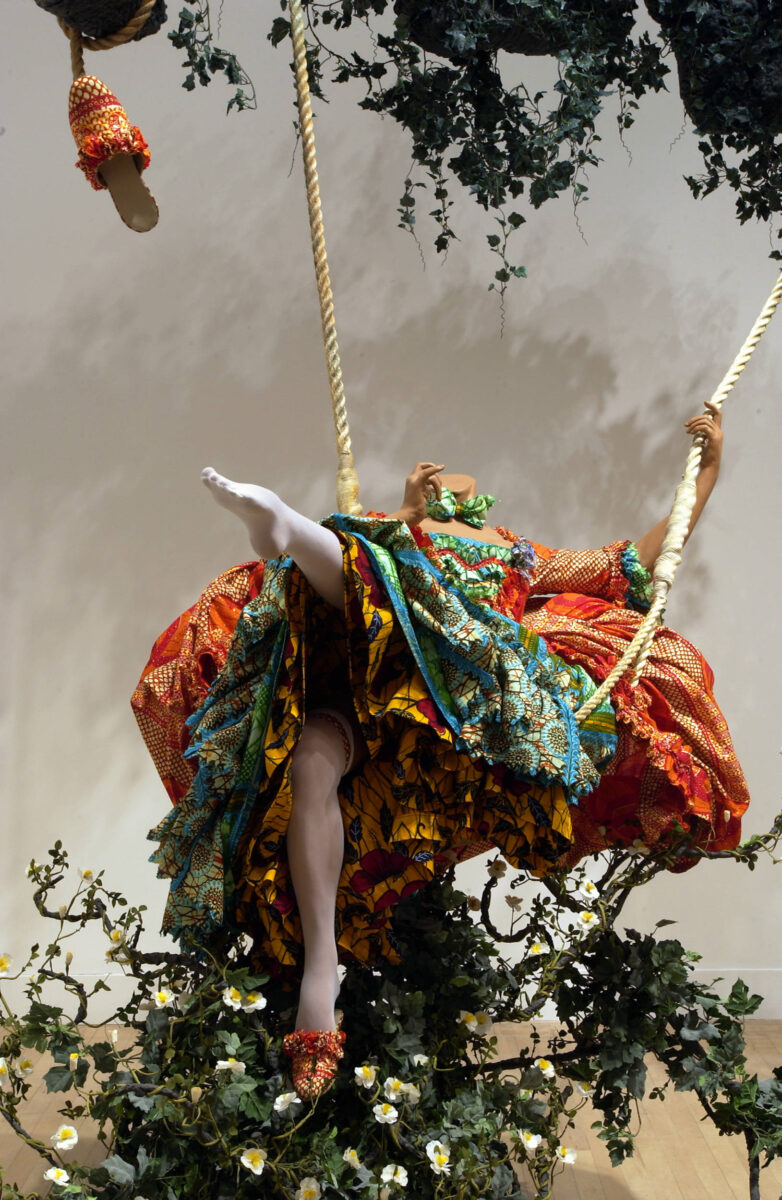
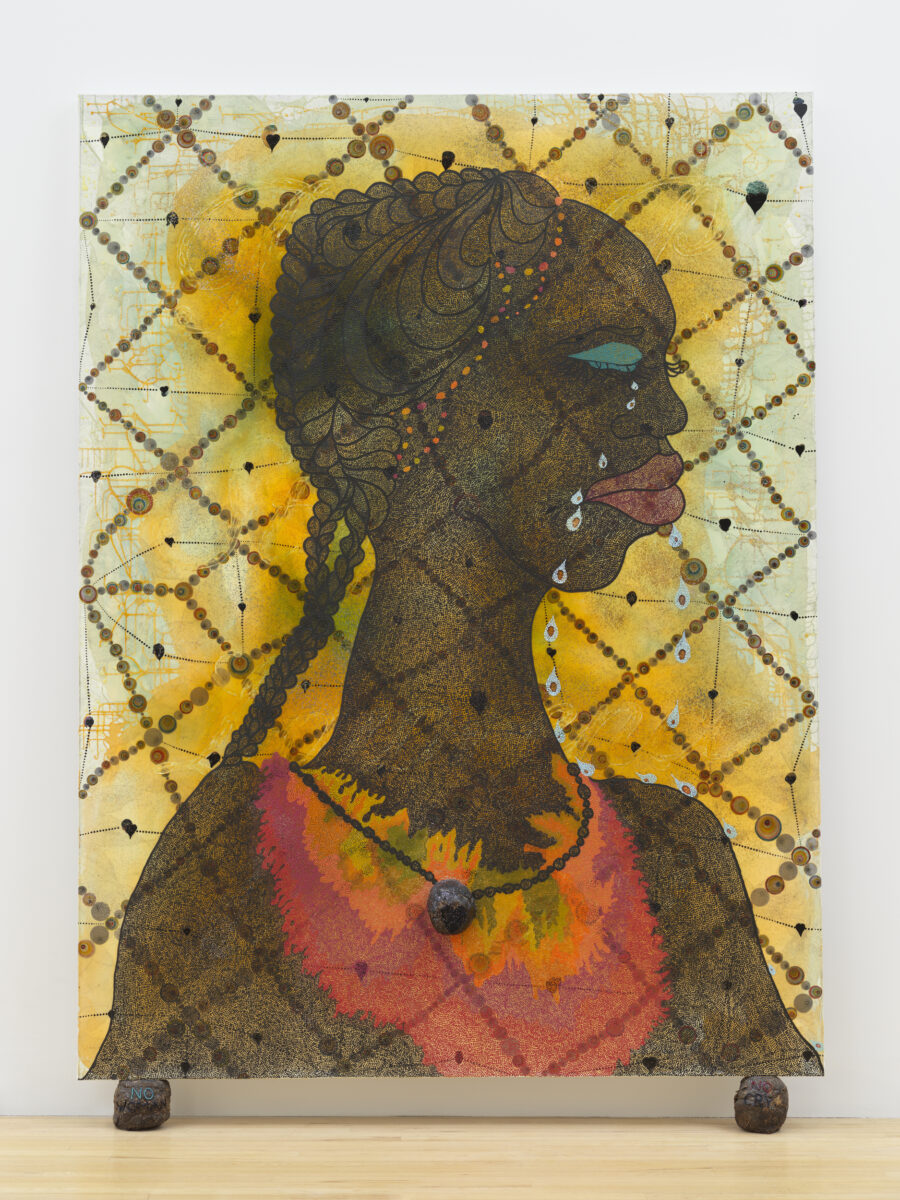
And also, when we think about fashion specifically, it’s mostly been concentrated in the main cosmopolitan cities, and here, it’s the 90s from a largely British lens. Where, nationally, was the furthest you went in terms of research exploration?
It was a really big, complicated show in a sense. We made it quite quickly in the end. I mean, Edward brings an unfamiliar amount of fashion experience. His editorial eye is extraordinary, and when you are looking at portfolios of all the great photographers of the era, 10 times out of 10, he sees the one. He knows the image.
Like perfect pitch, but for imagery.
Indeed. He’s brought that with him, and then we’ve spent the last year and a half with him brainstorming, and we’ve all just thrown ideas and images that resonated with us and spoke to our lives and our realities. We’ve introduced each other to things that I think we all feel [are] fresh and new. That’s what’s been so satisfying about the process of pulling it all together. But for me, what’s particularly satisfying is that fashion and art – as we have presented it – feel very harmonious and natural. We’re not pretending to be the Victoria and Albert Museum or the National Portrait Gallery – we love them – but this is a Tate show. We’ve tried to present it in a way that feels like us. We hope that it will have that lasting identity as something quite unique.
Absolutely. I also wanted to ask about that gorgeous hero image for the exhibition of a Young Pink Kate by Juergen Teller. It’s such a core image for so many, whether you lived through that period or post it, but what are some of the other core or key images that you’re looking forward to people seeing that also represent the time really well?
I’m going to throw in some iconic and less well-known things. I am a really big fan of a body of work in the first room of the show by Nigel Shafran. He is a photographer who is really celebrated for quietly depicting the very peripheral or the ordinary, and he went out in 1990 and shot teenagers at Brent Cross Shopping Centre, and I can’t help but feel like the people in these pictures were my friends. They got up that day, they did their hair, they got dressed, not knowing they were going to be photographed, and they look as regal as sitters in a Renaissance portrait. There’s such a wonderful way to start our storytelling about youth and possibility. We’ve also got some really iconic fashion by Vivienne Westwood in the last room of the show – I love Vivienne Westwood. I loved listening to her being interviewed, and I loved watching footage of her runway shows on the clothes show back in the day. There’s a particular look in the show that was worn by Naomi Campbell, and it consists of Scottish tartan, African head wrapping, and references to lots of different historical silhouettes. There’s also moving image footage of Naomi striding so confidently and so beautifully, in this ensemble, as the important symbol of Black beauty she is. It speaks to so much of what was going on in the world at that time in terms of politics and identity, so that’s a real highlight for me to have all of that collapsed into this one fashion look.
A lot of the exhibition also captures the youthful essence of the time, and that ties to both the rebellion and resilience, the beauty and the mess. There’s been a lot of conversation recently about Gen Z youth culture and the generations to come, in conjunction – or perhaps comparison – to all those that came before. What were some of your observations about those patterns of youth over time?
I think the main difference within that generational divide is that the 90s is the last analogue age. So we’ve got this incredibly weird opportunity for young people who have grown up in the digital world to connect with people their age who lived in a very different time. That slippage is going to be really interesting. I’m really excited to see how younger audiences are going to engage with the show. After all, they’re wearing 90s clothes and listening to 90s music. But again, this isn’t about nostalgia. But I hope that there is going to be this connection between how young people in the 90s, whether they are in the pictures or it’s the artists and the makers, see this idea that you can make something out of nothing. I hope that will land really powerfully because it’s certainly at the core of where I believe creative life comes from. So I really hope that young people will see that these creatives from all kinds of backgrounds- a lot of them are working-class kids who came to London, went to art school, had these incredible opportunities that we’ve lost now, but can take away that sense of the power of taking things into your own hands – the self-curation, the self-fashioning or the self-expression that was happening in the 90s is something that impacts vision now.
What do you think we need right now that the 90s had or gave us?
Affordable education. I was really lucky; I went to university at the end of the 90s. I grew up in a working-class family in the north of England. Going into the art world was just really alien – impossible for someone like me. And if it hadn’t been for the opportunities that there were, I don’t think I’d be doing what I do now. I don’t think I’d be able to do it again. So I feel quite passionate that a really key point of this show is that these people had this incredible opportunity to be who they wanted to be, but also to get the support and the training that they wanted to build these incredible careers. Art gives so many people an outlet and an escape. Whether they went through the artistic route or the conventional, traditional route, we’ve seen so many people from that period who are probably better off because they had this artistic outlet. I’ve been asked a lot of questions about the relationship between the 90s and the 60s, and we see that same “boom and bust” period where, when a country is in economic health and growth, youth and creativity cry. We’ve seen that pattern over the course of the last 50 years, so let’s hope it’s getting its feet here.
Words – Aswan Magumbe


